Showing posts with label Jonathan Silver. Show all posts

Monday, December 24, 2012

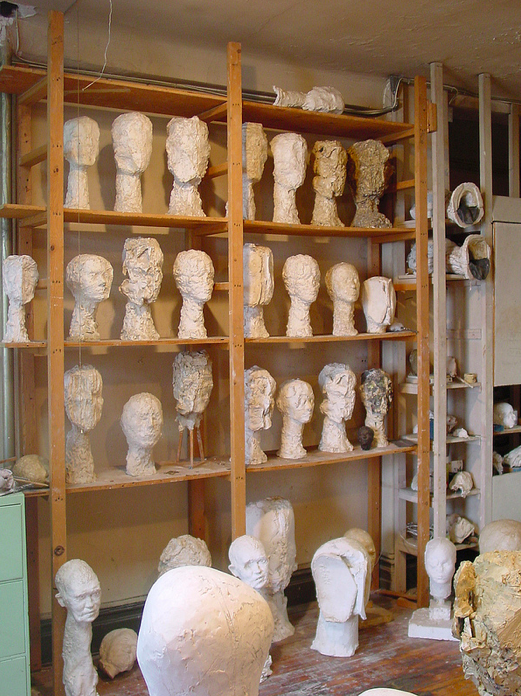
Jonathan Silver's Studio, As Photographed by Michael O'Keefe


For most of his artistic life, Jonathan Silver worked in a crowded, third-floor loft space on East 4th Street in Manhattan.  "The 4th Street studio was an environment in itself when Jonathan was in it,” Marion Smit, Silver’s longtime assistant, wrote in an email.  “I spent quite a bit of time [there] in the early- to mid-eighties, sometimes helping Jonathan with various things or just sitting there listening and talking to him while drinking some of that delicious coffee/ heavy cream/ sugar concoction he used to make. Talking with Jonathan was always a pleasure. He was to the point and incredibly engaging, sometimes acerbic. He was erudite beyond belief and passionate.  His commitment to, knowledge of, and involvement with music and art was total. He lived it, he was in it. The studio was a physical manifestation of that. Literary passages, phone numbers, engagements were scrawled in pencil on the walls, chunks and shards of plaster and plaster dust covered the floor, various versions of 'Wounded Amazon', 'Eve',' Half Eve' were in the process of being worked or reworked, part clay/ part plaster, fragments scattered around, books here and there, and the piano in the middle of it all."  

After Silver died in 1992, his wife Barbara preserved the space largely as it was when he was alive.  Over the years, she has admitted visitors by request—friends, former students, and admirers.  One of these admirers was the young artist Michael O’Keefe, who, in the early 2000’s, visited the studio twice, taking the photos included here.  (See all of O’Keefe’s photos here.)  In the text below, written in 2011, O’Keefe describes his experience.


The first time I visited Jonathan's studio was well after his death, some time around 2001 or 2002. Barbara Silver graciously had me into her apartment above the studio. She greeted me at the door and then, as if it was the obvious thing to do (and, as far as I was concerned, it was) she began to give me a tour of the work in the house which included many paintings, drawings and sculptures made by Jonathan, but also a few works by artists that were close to Jonathan, most notably Christopher Cairns and Bruce Gagnier.  After looking at the work we sat down for tea and a little history of Jonathan. From that conversation I remember her description of Jonathan's love of classical music, the piano and for Beethoven, specifically. And I recall Barbara's comments about how at the end of his life Jonathan worked very late into the night and while doing so listened to strange talk-radio shows, what she described as "Christian radio".


Upon entering the studio I was struck by the amount of work that was still present in this space that had not been used for many years. Barbara mentioned that it was more or less just as he left it, except she had recently swept up the plaster dust that covered the floor. One could easily imagine this room with an overwhelming amount of dust and debris as there was a lot of work in a relatively small space and the work was clearly made with some degree of violence and excitement.  I imagined piles of discarded sculptures, molds, shards, etc., that Jonathan would have turned to as his stockpile of materials.  


Barbara left me to look around. I had only ever heard about Jonathan and seen just a few of his sculptures, and so this was a large dose of the artist, all at once. There was writing all over the walls, oftentimes illegible. I recall making out some things about Rodin, something to do with Rodin's use of "color", meaning light, I think.  Most of the legible writing seemed over my head or hard to piece together its relevance to the work - it was very clear that Jonathan had a massive intellect. But the work itself is more often ruled by expressionistic desires. 
Every part of the studio, including all of the work and even the lighting in the space, seemed to be perfectly aligned with the image I had in mind of what Jonathan looked like, his dark, wild hair and his serious eyes.  

After looking closely at the many sculptures in the front room I went into the small back room where I sat down with the stacks of drawing pads that were there on a table. I flipped through hundreds of drawings, most of them very small, all of them careful and precise while maintaining a remarkable sense of spontaneity. Discovering the work in these drawing pads remains one of the most exciting and inspiring art viewing experiences of my life. 


Two years later I returned to the studio to look again at the drawings and to take some photographs.  Two years later the front studio looked exactly the same, still preserving the point in time when Jonathan’s short adventure as an artist came to a relatively abrupt and maybe premature end.  By that time the drawings in the back room had been moved from the table into a closet. I shudder to think where the final resting place might be for these important and beautiful drawings.


Click on photos to enlarge.

See more of Michael O'Keefe's photos of Silver's studio on our Flickr page.

Learn more about Jonathan Silver on his profile.


Tuesday, August 23, 2011

Jonathan Silver

J.Silver in studio, 1983


“Silver’s sculpture is steeped in classical and religious myth.  It is assembled, however, with a keen sense of modernist history, in particular, of the formal and psychological implications of Cubism and Surrealism.  In Silver’s work, myth is not quiet and controllable, but something that grows and evolves on its own and obliges mere mortals to flail away in its wake.” (Michael Brenson, 1984, The New York Times)


Barbarian killing his wife, 1985


Jonathan Silver was born in New York City in 1937.  He decided not to go to high school, preferring to be educated by tutors at home.  He received a B.S. degree in general studies from Columbia University and later enrolled in the Art History Ph.D. program under the famed historian, Meyer Schapiro.  Schapiro was impressed by Silver’s intellectual prowess and supported his dissertation on Giacometti.  Silver, however, started making sculpture seriously in the late 1960’s and never completed his doctorate.  As a Columbia student, he drew in Peter Agostini’s class between 1960 and 1966, where he met future colleagues Christopher Cairns and Bruce Gagnier in 1965.


head, 1974, plaster

head, 1975, plaster

During the 1970’s Silver worked alongside Cairns, collaborating on ideas for heads and figures.  The two approached their work with the ambition and stamina of scientists tackling big questions, in it for the long haul; it was clear they neither expected, nor were interested in, quick or dramatically “personalized” solutions.  Cairns and Silver developed a common method of assembling and reassembling, or embedding fragments of one head or figure into another, thus creating new works.  The sculpture produced during this period was shown by Silver and Cairns at the 4x10 Gallery in New York in 1976.  The same year they showed at Haverford College’s Comfort Gallery with their fellow alumnus from Agostini’s class, Bruce Gagnier.  Cairns and Silver also exhibited together at the Weatherspoon Gallery in Greensboro, NC, in 1978, and at the New York Studio School in 1979.


Agamemnon, 1977, mixed media


Silver began working on larger figures in the early 80’s.  Abounding with classical, mythical and art historical references, these ambitious works further developed the method of combining and recombining elements from several different pieces.  Elaborately constructed, they often included found objects or sections of the plaster molds themselves. Wounded Amazon, which is in the Walker Art Center Sculpture Garden, dates from this period.  Silver liked to say his work “tended towards the Greco-Oriental.”


Wounded Amazon, 1984, plaster

A visit to the Medici Chapel while traveling in Italy with Cairns in 1982 was formative.  Silver began experimenting with placing groups of figures together in a room, leading to his Room Dedicated to Septimius Severus, exhibited with other large pieces at the Gruenbaum Gallery in Soho in 1985.  Shows at the Victoria Munroe Gallery followed in the early 1990’s.


Chapel of Septimius Severus, 1985-86

During the last seven years of his life, Silver worked on rooms of sculpture, including the Lower Room installed at the Sculpture Center in 1990.  Consisting of a dramatic ensemble of figures evoking the disabling effects of memory and aging, the room was filled with figures seized by uncontrollable and incomprehensible forces.  Silver’s late works were often scenes of torment or rage, where the expressionistic surface treatment contributed to their high emotional pitch.


The Lower Room, 1989, mixed media


“Silver’s figures are survivors.  They are vulnerable, yet unalterable, sacrificial, yet in command.  Violence has been done to them, but through their statuesque power, or through the force of their will or rage, they retain the ability to avenge or punish, and to impose themselves on their situations.”  (Michael Brenson, 1995)


Birth of Venus, 1985-86


Chance, 1987-1990, plaster


Silver spent his entire life drawing from the model.  He would stand at an easel, drawing with a number 2 pencil, making small, exquisitely constructed figure drawings.  He also drew incessantly while watching television.


head, 1977, mixed media

To support himself, Silver taught Art History at Montclair State College in Montclair, NJ.  Noreen Sanders, a student of his in the late 70’s, wrote in an email, "In class, he would walk up on the stage, in front of the screen and directly into the paintings he put in the slide projector… talking passionately about the piece (good or bad) – smoking Kool cigarettes with his saggy-ass jeans and bits of plaster stuck in his hair.  He would assign novels from the same time period.  Before class, you could catch him playing piano – some Schubert piece or other.  Or he’d recite poetry.  For me, the work came alive." 

Silver was a frequent lecturer and visiting critic at the New York Studio School and at Haverford College, where he had a profound influence on students for over twenty years, inspiring those who worked closely with him by his penetrating intelligence, erudition and aesthetic probity and his willingness to share his perceptions.  Silver wrote and published extensively on art historical topics.  His articles on Giacometti and David Smith were published by ArtNews.


The New Gretchen, 1991


Jonathan Silver died in New York in 1992 at the age of 54.  There was a posthumous show of his heads at the Sculpture Center in 1996 and one of heads and figures at Lori Bookstein Fine Art in 2008, co-curated by Cairns’ son Nicholas.


figure, 1983


Text adapted with permission from an essay in the exhibition catalog for the 2006 show Five Sculptors.

Additional photos of Jonathan Silver's work can be viewed on our Flickr page.


Photo of Silver is from the announcement card of the 2008 exhibition of his work at Lori Bookstein Fine Art.

See also:
Jonathan Silver: Drawings
Jonathan Silver's Studio, As Photographed by Michael O'Keefe

Friday, May 28, 2010

Jonathan Silver: Drawings


Jonathan Silver drew well, and he drew often.

In the sixties, he drew in Peter Agostini's class at Columbia, and in studios on 14th Street and Spring Street in Manhattan, where, for a few bucks, you could draw from the model for several hours.

In the afternoons, he would drop in at the New York Studio School on 8th Street--into classes taught by Peter Agostini, Chris Cairns or George Spaventa--and stand in the corner and draw while smoking cigarettes.

He drew at the Metropolitan Museum of Art from art of the distant past, including Greek and Egyptian sculpture.

Later in life, he would draw at night in front of the television while watching crime drama Kojak or New York Mets baseball.

Silver, who was left-handed, usually drew small--8 x 10 inches or less--using a standard Number 2 pencil with an eraser on the end, often on pads of paper his friend Bruce Gagnier would bring back from Sennelier, in Paris.  His drawings were highly restrained, tightly constructed, exact, and disciplined.  He admired Da Vinci and Michelangelo for their rigorous approach, and adopted from Agostini, whose drawings he especially emulated, a method of making a line with a heavy, abrupt ending point--almost a dot--at the end, like a period at the end of a sentence.

Away from the model, his subjects were most often heads or figures--also methodically composed and constructed--mirroring whatever he was doing in sculpture at the time, until the very end of his life, when, as lung cancer was swiftly killing him, his subjects--animals and humans--became more fantastical and frightening.

Click on images to enlarge.


     Three drawings from the 1970's


Three drawings from the 1980's


Three drawings from the 1990's


See more drawings by Jonathan Silver on our Flickr page.

Learn more about Silver on his profile.