Showing posts with label New York City. Show all posts

Monday, December 24, 2012

Jonathan Silver's Studio, As Photographed by Michael O'Keefe


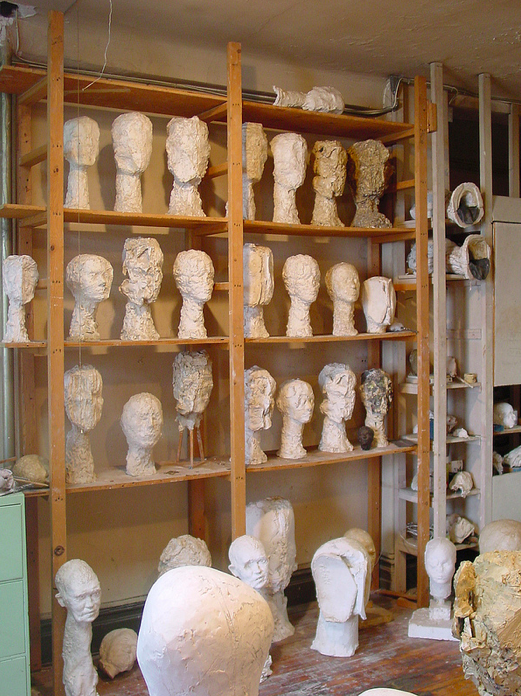
For most of his artistic life, Jonathan Silver worked in a crowded, third-floor loft space on East 4th Street in Manhattan.  "The 4th Street studio was an environment in itself when Jonathan was in it,” Marion Smit, Silver’s longtime assistant, wrote in an email.  “I spent quite a bit of time [there] in the early- to mid-eighties, sometimes helping Jonathan with various things or just sitting there listening and talking to him while drinking some of that delicious coffee/ heavy cream/ sugar concoction he used to make. Talking with Jonathan was always a pleasure. He was to the point and incredibly engaging, sometimes acerbic. He was erudite beyond belief and passionate.  His commitment to, knowledge of, and involvement with music and art was total. He lived it, he was in it. The studio was a physical manifestation of that. Literary passages, phone numbers, engagements were scrawled in pencil on the walls, chunks and shards of plaster and plaster dust covered the floor, various versions of 'Wounded Amazon', 'Eve',' Half Eve' were in the process of being worked or reworked, part clay/ part plaster, fragments scattered around, books here and there, and the piano in the middle of it all."  

After Silver died in 1992, his wife Barbara preserved the space largely as it was when he was alive.  Over the years, she has admitted visitors by request—friends, former students, and admirers.  One of these admirers was the young artist Michael O’Keefe, who, in the early 2000’s, visited the studio twice, taking the photos included here.  (See all of O’Keefe’s photos here.)  In the text below, written in 2011, O’Keefe describes his experience.


The first time I visited Jonathan's studio was well after his death, some time around 2001 or 2002. Barbara Silver graciously had me into her apartment above the studio. She greeted me at the door and then, as if it was the obvious thing to do (and, as far as I was concerned, it was) she began to give me a tour of the work in the house which included many paintings, drawings and sculptures made by Jonathan, but also a few works by artists that were close to Jonathan, most notably Christopher Cairns and Bruce Gagnier.  After looking at the work we sat down for tea and a little history of Jonathan. From that conversation I remember her description of Jonathan's love of classical music, the piano and for Beethoven, specifically. And I recall Barbara's comments about how at the end of his life Jonathan worked very late into the night and while doing so listened to strange talk-radio shows, what she described as "Christian radio".


Upon entering the studio I was struck by the amount of work that was still present in this space that had not been used for many years. Barbara mentioned that it was more or less just as he left it, except she had recently swept up the plaster dust that covered the floor. One could easily imagine this room with an overwhelming amount of dust and debris as there was a lot of work in a relatively small space and the work was clearly made with some degree of violence and excitement.  I imagined piles of discarded sculptures, molds, shards, etc., that Jonathan would have turned to as his stockpile of materials.  


Barbara left me to look around. I had only ever heard about Jonathan and seen just a few of his sculptures, and so this was a large dose of the artist, all at once. There was writing all over the walls, oftentimes illegible. I recall making out some things about Rodin, something to do with Rodin's use of "color", meaning light, I think.  Most of the legible writing seemed over my head or hard to piece together its relevance to the work - it was very clear that Jonathan had a massive intellect. But the work itself is more often ruled by expressionistic desires. 
Every part of the studio, including all of the work and even the lighting in the space, seemed to be perfectly aligned with the image I had in mind of what Jonathan looked like, his dark, wild hair and his serious eyes.  

After looking closely at the many sculptures in the front room I went into the small back room where I sat down with the stacks of drawing pads that were there on a table. I flipped through hundreds of drawings, most of them very small, all of them careful and precise while maintaining a remarkable sense of spontaneity. Discovering the work in these drawing pads remains one of the most exciting and inspiring art viewing experiences of my life. 


Two years later I returned to the studio to look again at the drawings and to take some photographs.  Two years later the front studio looked exactly the same, still preserving the point in time when Jonathan’s short adventure as an artist came to a relatively abrupt and maybe premature end.  By that time the drawings in the back room had been moved from the table into a closet. I shudder to think where the final resting place might be for these important and beautiful drawings.


Click on photos to enlarge.

See more of Michael O'Keefe's photos of Silver's studio on our Flickr page.

Learn more about Jonathan Silver on his profile.


Tuesday, August 23, 2011

Jonathan Silver

J.Silver in studio, 1983


“Silver’s sculpture is steeped in classical and religious myth.  It is assembled, however, with a keen sense of modernist history, in particular, of the formal and psychological implications of Cubism and Surrealism.  In Silver’s work, myth is not quiet and controllable, but something that grows and evolves on its own and obliges mere mortals to flail away in its wake.” (Michael Brenson, 1984, The New York Times)


Barbarian killing his wife, 1985


Jonathan Silver was born in New York City in 1937.  He decided not to go to high school, preferring to be educated by tutors at home.  He received a B.S. degree in general studies from Columbia University and later enrolled in the Art History Ph.D. program under the famed historian, Meyer Schapiro.  Schapiro was impressed by Silver’s intellectual prowess and supported his dissertation on Giacometti.  Silver, however, started making sculpture seriously in the late 1960’s and never completed his doctorate.  As a Columbia student, he drew in Peter Agostini’s class between 1960 and 1966, where he met future colleagues Christopher Cairns and Bruce Gagnier in 1965.


head, 1974, plaster

head, 1975, plaster

During the 1970’s Silver worked alongside Cairns, collaborating on ideas for heads and figures.  The two approached their work with the ambition and stamina of scientists tackling big questions, in it for the long haul; it was clear they neither expected, nor were interested in, quick or dramatically “personalized” solutions.  Cairns and Silver developed a common method of assembling and reassembling, or embedding fragments of one head or figure into another, thus creating new works.  The sculpture produced during this period was shown by Silver and Cairns at the 4x10 Gallery in New York in 1976.  The same year they showed at Haverford College’s Comfort Gallery with their fellow alumnus from Agostini’s class, Bruce Gagnier.  Cairns and Silver also exhibited together at the Weatherspoon Gallery in Greensboro, NC, in 1978, and at the New York Studio School in 1979.


Agamemnon, 1977, mixed media


Silver began working on larger figures in the early 80’s.  Abounding with classical, mythical and art historical references, these ambitious works further developed the method of combining and recombining elements from several different pieces.  Elaborately constructed, they often included found objects or sections of the plaster molds themselves. Wounded Amazon, which is in the Walker Art Center Sculpture Garden, dates from this period.  Silver liked to say his work “tended towards the Greco-Oriental.”


Wounded Amazon, 1984, plaster

A visit to the Medici Chapel while traveling in Italy with Cairns in 1982 was formative.  Silver began experimenting with placing groups of figures together in a room, leading to his Room Dedicated to Septimius Severus, exhibited with other large pieces at the Gruenbaum Gallery in Soho in 1985.  Shows at the Victoria Munroe Gallery followed in the early 1990’s.


Chapel of Septimius Severus, 1985-86

During the last seven years of his life, Silver worked on rooms of sculpture, including the Lower Room installed at the Sculpture Center in 1990.  Consisting of a dramatic ensemble of figures evoking the disabling effects of memory and aging, the room was filled with figures seized by uncontrollable and incomprehensible forces.  Silver’s late works were often scenes of torment or rage, where the expressionistic surface treatment contributed to their high emotional pitch.


The Lower Room, 1989, mixed media


“Silver’s figures are survivors.  They are vulnerable, yet unalterable, sacrificial, yet in command.  Violence has been done to them, but through their statuesque power, or through the force of their will or rage, they retain the ability to avenge or punish, and to impose themselves on their situations.”  (Michael Brenson, 1995)


Birth of Venus, 1985-86


Chance, 1987-1990, plaster


Silver spent his entire life drawing from the model.  He would stand at an easel, drawing with a number 2 pencil, making small, exquisitely constructed figure drawings.  He also drew incessantly while watching television.


head, 1977, mixed media

To support himself, Silver taught Art History at Montclair State College in Montclair, NJ.  Noreen Sanders, a student of his in the late 70’s, wrote in an email, "In class, he would walk up on the stage, in front of the screen and directly into the paintings he put in the slide projector… talking passionately about the piece (good or bad) – smoking Kool cigarettes with his saggy-ass jeans and bits of plaster stuck in his hair.  He would assign novels from the same time period.  Before class, you could catch him playing piano – some Schubert piece or other.  Or he’d recite poetry.  For me, the work came alive." 

Silver was a frequent lecturer and visiting critic at the New York Studio School and at Haverford College, where he had a profound influence on students for over twenty years, inspiring those who worked closely with him by his penetrating intelligence, erudition and aesthetic probity and his willingness to share his perceptions.  Silver wrote and published extensively on art historical topics.  His articles on Giacometti and David Smith were published by ArtNews.


The New Gretchen, 1991


Jonathan Silver died in New York in 1992 at the age of 54.  There was a posthumous show of his heads at the Sculpture Center in 1996 and one of heads and figures at Lori Bookstein Fine Art in 2008, co-curated by Cairns’ son Nicholas.


figure, 1983


Text adapted with permission from an essay in the exhibition catalog for the 2006 show Five Sculptors.

Additional photos of Jonathan Silver's work can be viewed on our Flickr page.


Photo of Silver is from the announcement card of the 2008 exhibition of his work at Lori Bookstein Fine Art.

See also:
Jonathan Silver: Drawings
Jonathan Silver's Studio, As Photographed by Michael O'Keefe

Monday, August 15, 2011

Agostini in Soho // by Scott Sherk


One day, sometime in the 70’s when I was attending Haverford College, I was invited by my teacher, Chris Cairns, to go to New York to do something with Peter Agostini.  Chris had organized a retrospective exhibition of Agostini’s sculpture at the college, and we were returning the work to Agostini’s Greene Street building.  I seem to recall that we had some difficulty locating Agostini—the buzzer at the building was either non-existent or broken.  There was waiting around.

Soho in those days was a very different place.  Large trucks were parked along the loading docks and the area looked rough.  The sidewalks were mostly empty with an occasional worker passing.  Trash was present.  Greene Street was barren— no boutiques, no bars, no cappuccino, no tourists.  I was left on the street to guard the van.  Sometime later I was sent out to find coffee, which I bought from a window somewhere, maybe on Broome Street.  There were no restaurants.  Sometime later, I helped load things into Agostini’s elevator and into the basement.  Upstairs his loft was raw, filled with stuff, and very dark.  He was still living in the East Village.  I vaguely remember a washing machine.
Eventually Chris, Agostini, and I walked over to West Broadway. Chris and Agostini were deep in conversation with me following a step behind when we were hailed from across the street, “Peter!  Pete! Great to see you!”  Agostini stopped in his tracks and turned to face a dapper young man who was rapidly crossing Spring Street.  The guy was really happy to see Agostini and gushed about him and his work.  This short conversation reached its climax when he said something like, “Let’s do something, Peter.   I really want to show your work.  Let’s do a show.”  Agostini looked alarmed and said, “Can’t you see I’m talking to my friend Chris?” and we walked away.  
“Jeez”, I thought, ”so this is how it works”.


Scott Sherk is an artist living in Pennsylvania with his wife, artist Pat Badt.  He is a professor of art at Muhlenberg College and his work is exhibited regularly at the Kim Foster Gallery in New York.  His work can be viewed at thethirdbarn.org.

Learn more about Peter Agostini on his profile.

Photos from WiredNY.com


Friday, December 31, 2010

Charles Seliger // by Nicholas Cairns


Charles Seliger (1926-2009) represents an interesting crosscurrent to the general trend lines of what is called the Abstract Expressionist movement. A first generation AbExer, albeit the youngest of the group, Seliger somehow managed to avoid the pitfalls of both the fame and the ridiculous obsession with scale that plagued so many of his contemporaries. Throughout a career that spanned seven decades, he was able to maintain a near monofocus on his interest, which, as he stated very early on, was to ‘apostrophize micro-reality’.


Hidden Skeleton  1945

Creating small paintings that rarely exceeded 30 inches in any dimension, and were often much smaller, Seliger painted an intimate world of kaleidoscopic and biomorphic forms that suggest microcosmic life. In his own words: “My work, even when most abstract, reflects the natural world. Strata of the earth, forms relating to botany and biology and the ocean depths, all figure in the imagery of my work, no matter how abstract. The images are developed with a feeling for the intricacy of the structure of matter. There is a sense of something happening organically among the forms. The images are changing, there is suggestion of movement in the earth, of botanical development, always a sense of growth. A metamorphosis occurs.”

Chrysanthemums  1952
           
In his teens and early 20’s, Seliger developed a close association with two figures who would prove to be instrumental in his maturation as an artist. Seliger first met Jimmy Ernst in 1943 at Peggy Guggenheim’s renowned Art of this Century gallery, where Jimmy was Peggy’s secretary and where Seliger had his first one man show in 1945 at the age of 19. On the first day that they met, Jimmy, after seeing one of Seliger’s paintings, suggested that Charles look at the British publication, London Bulletin, that presented the work of European Surrealist artists like Jimmy’s father, the German painter Max Ernst. The work presented in this magazine, particularly that of Max Ernst, had a profound effect on Seliger and it was through careful study of these Surrealist paintings that Charles began to develop a painting method that used a variety of automatic means to generate a range of unpredictable and non-preconceived naturalistic imagery. It was these processes and the imagery that emerged from them that would serve as the bedrock of his work for the rest of his career.


Luminous Field  1965

It was also during this early period that Seliger encountered Mark Tobey, a Pacific Northwest artist. Tobey, a Bahai, painted on a small scale and with a certain Eastern philosophical or mesmeric/mystical approach that connected to Seliger’s ethos. Tobey had quite an effect on many New York artists of the day, particularly Jackson Pollock, who made a habit of attending all of Tobey’s Willard Gallery shows in NYC, and whose most characteristic work appears, at times, to be simply a scaled up and sped up version of the intricately woven and near-etched paintings of Mark Tobey. But for Seliger, Tobey’s influence was more ingrained. Seliger, through Tobey, must have seen a legitimate alternative to the large scale, often breezy, paintings of the day in NYC, a way of painting that allowed for an attachment to the subject that was intimate and not distant, reflective and meditative, not concept or ‘action’ driven. And the small scale and finely drawn elements in the work of both Seliger and Tobey encourage a certain reflectivity on the part of viewers as well, in effect willing them to stand very close to the work, and to peer into it as one would into a telescope or microscope.


Prophecy 1985

Seliger lived most of his adult life in Mount Vernon, New York, where he maintained a full-time job at Commercial Decal for 5 decades. He painted at night when he returned from his job and, working slowly and steadily, often produced no more than 10 paintings a year. From 1989 to the present, Charles Seliger has been represented by Michael Rosenfeld Gallery on 57th St. in NYC.


Runic Veil  1989

“'I need not be afraid of the void. The void is part of my person. I need to enter consciously into it.'  This is a quote from Paul Tillich… It struck me that it is this void I enter when I paint… by making it a part of yourself one can then deal better with the despair. For me the void is the endless changing-changeless world of organic being. Becoming from this void, I try to extract (from my experience during the process of painting) some visual evidence of what I see or feel in the void. No matter how I plan a painting, or try to work the concept out in advance, I fail. Only when I enter the painting as a void where I know nothing but must retrieve from the void evidence of my consciousness – evidence of the struggle of the organism to become, to emerge… only to pass again therein is the never ending cause of despair… but one must carry the void within – and not fear but rather celebrate its beauties, ecstasies and endless complication… beyond our minds. I never seem to know where my paintings come from – or how they come about. One must look into the emptiness and the artist must not come back empty handed." – 1972


Transcendence  1993

Nicholas Cairns is a painter who has exhibited in New York City, Philadelphia, Baltimore and Dallas. He lives in Baltimore with his wife, artist Elizabeth Wade. See his work online at www.nicholascairns.com.


All biographical details and quotes are taken from Charles Seliger by Francis O'Connor


Monday, December 20, 2010

Peter Agostini's 12th Street Studio, as Photographed by David Carrow

For most of the 1960’s, Peter Agostini had a studio on 12th Street in Manhattan, between Avenues B and C.  In the early 70’s, he purchased a building on Greene Street in Soho, and the12th Street studio was left unused for several years.

David Carrow, who was a student of Agostini’s at the New York Studio School, and later, his graduate assistant at UNC Greensboro, remembers telling Agostini he wanted to photograph the old studio before it was cleared out.  “The place had become sort of a tomb," he told me recently.  "It was very quiet and dusty.  There was no activity in there, which was so interesting.  I remember just saying, I gotta get in here and take some pictures because this is just fantastic with the light coming in on all the plaster and just the kind of decay and deterioration that was there, because nobody had been moving things around for a while.”

The resulting photographs, 20 in number, show the studio as it stood sometime in the early 70’s.  Agostini worked mostly in plaster during his years on 12th Street, making many of his famous swells, cast balloons, drapery and found objects, and these pieces can be seen as they sat on that day, abandoned and in disrepair, covered in dust, beautifully lit by a combination of natural light and fluorescents.

The studio space measured 125 by 25 feet, with concrete floors, a sink, one skylight and a four-burner stove, the only source of heat.  Eventually the building, across the street from Public School 61, was condemned and became a parking lot.  Where the pieces in the photos are today is unknown, as is the exact date these photographs were made.


See more of these photos on our Flickr page.

Click photos to enlarge.


Learn more about Peter Agostini on his profile.

Friday, July 23, 2010

Christopher Cairns on Earl Kerkam

You can look all you want to on the internet, but will find very little about the painter Earl Cavis Kerkam. And what little you do find will be deeply unsatisfactory. There are biographies on Artnet, etc. (if you want to pay for them) listing general dates, events and places--all of which are of little interest. 

                                                    Self-portrait, 1963 


I saw my first Kerkam painting in the early seventies in a show at the New York Studio School on 8th Street.  It was a small oil, an abstract frontal head from the early sixties. The painting belonged to the Poindexter family who ran the Poindexter Gallery in the 1950’s and 60’s. This gallery showed Earl Kerkam as well as George Spaventa. Years later, in 2005, I got to show one of my sculptures in a show at the NYSS which included this very same Kerkam painted head. At that time, as well as 35 years prior, I wanted to steal this little beauty. This particular painting, in and of itself, puts Kerkam in the top rank of American painters of the 20th century. Check out some of the others. Forgotten though he is, Kerkam had some extraordinary strengths.

In the early 1970’s, my friend Jonathan Silver and I were both working on frontal sculpted (and drawn) heads. I told him about the outstanding little painting at the NYSS and together we took a look. This little Kerkam head had a big effect on us both. Of course there were many other things that we also had on our minds during those years, including Roman heads, Medardo Rosso, psychoanalysis, Hans Holbein, Giacometti, Ernst Gombrich, Ernst Kris and F.X. Messerschmidt. But this head had a big impact on both of us.

Earl Kerkam lived in New York and Paris. He had a regular job for many years and also a wife and three kids--and then, a la Gauguin, he abandoned his family and spent the rest of his life painting, seemingly on his own.  Two articles in Art News, one by Elaine de Kooning (“Kerkam Makes a Painting”) and one by Louis Finkelstein, make unsuccessful stabs at shedding light on this artist. There are a few catalogues of his work, principally one from a 1966 memorial show at the Washington Museum of Modern Art, now long since defunct.

For a clearer idea of this artist, one must go to the paintings themselves (and photographs of the artist in his studio) along with a few quotes and anecdotes that can be retrieved from the scrapheap of history.
 
Pictures show Kerkam painting, shirtless or in an old-fashioned undershirt, in a dilapidated and disheveled studio, often with a model. Various photographers took pictures of him, and a number can be seen in the records of the Archives of American Art.  No one knows how he managed to make a living. His friends Pollock, de Kooning and Kline saw him as uncompromising. Pollock is said to have waved a postcard in the Cedar Tavern one night declaring, “Earl says that I’m not bad!” (This postcard came after Kerkam had seen a Pollock show in Paris.) Franz Kline said that “Earl could paint in a telephone booth.”


                                                   Kerkam in Studio 1950's

Kerkam had a curious approach to painting. Often using a model, he might start with a voluptuous female model and by the time the painting was finished it would have morphed into a strong male figure.  He seems to have had a generalized idea of the figure, perhaps derived from his own physique. On the other hand, his portraits of the 30’s and 40’s often have a very specific look, as if they are particular people. It is interesting to learn, however, that he often used multiple models for the same portrait, so the specificity very well might have been a conglomeration or synthesis of their individual attributes. In this way he was a bit like Sherwood Anderson. Kerkam himself said, “I try to paint a construction instead of a sensation.” Earl Kerkam was obsessed with painting. “I can’t talk French, but I can paint French,” he liked to say.

One finds this on the Mercury Gallery site: 

“An artist must get rid of all encumbrances,” [Kerkam] told a friend. His apartment was “so sparsely furnished," wrote Finkelstein in Art News, “that it did not look furnished at all… There was a broken-down cot with a slab of foam rubber… [and] a bucket  for washing his clothes (which he sometimes let burn on the stove while he was painting)"... Once, a Seattle heiress arrived with $1,000 to have Kerkam paint her picture. He opened his door a crack, gave her the once-over and said: “You're too pretty. Go away.”

On a more obscure website is this: “Earl Kerkam was holding court at his one-man show at the Bonestell Gallery. He was complaining that some of his models refused to pose in the nude…'Well paint them with their clothes on!' someone said. 'That’s no good,' answered Kerkam. 'Painting a woman who won’t take her clothes off is like interviewing a woman who won’t tell the truth.' Max Weber hit the nail on the head when he said: “Kerkam has more art in a stroke than most men get in a whole painting.” One can see this written all over his paintings.


                                                        Head of man, 1940's 

Kerkam showed at the Poindexter Gallery, the World House Gallery and the Charles Egan Gallery. Galleries were different in those days. Artists did not snivel at the feet of the gallerist, as is now the practice. A gallery director or owner like Charles Egan or Stephen Radich or Curt Valentine took a direct personal interest in their artists. The relationship was partly business, partly personal, a far cry from the strictly commercial business strictures of today. Egan would support his artist whether or not she or he sold, and sales weren’t common. In other words, he gave them a modest stipend. Poindexter must have done the same.

People can make all the excuses they want--about why things were the way they were then and why things are the way that they are now--but these are only hapless excuses masking a deep and unabiding lack of aesthetics and feeling on the part of all contemporary gallery owners. In the 1940’s and 50’s, gallery owners would take care of their artists. Later, in the seventies, newer owners really learned to “take care” of their artists. 

Earl Kerkam died at the age of 74 in 1965, shortly after beginning to teach at the newly formed New York Studio School. Mercedes Matter thought he would be a good teacher but he did not live long enough for anyone to find out. The painter Chuck O’Connor has fond memories of Earl Kerkam in the fall of 1964. I either did or did not meet Earl Kerkam, although I like to think that I did.

After all is said and done, we have to let the paintings speak for themselves and rely on the audience to establish the necessary context for these works--if that is possible in this day and age.

After Kerkam’s death, Zabriskie Gallery had a show of his work. Hilton Kramer, the vaunted art reviewer for The New York Times, led Kerkam on his way to oblivion with a review entitled "Earl Kerkam: A Sensibility Unfulfilled; Late Painter's Work on View..." You can look up the review and pay to read it, but why bother? Kramer did the same shit with Peter Agostini. This guy Kramer was the worst--and he did a great deal of damage.

Here is a review by Victoria Donohoe from 1967. (In 2010, Victoria Donohoe continues to write her fine reviews for The Philadelphia Inquirer.):

Earl Kerkam Show: Elegant Fleshiness
The Philadelphia Inquirer--Sunday, November 12, 1967

The Earl Kerkam (1891-1965) show at Johnny Aiello's “Gallery Pane Vino,” 20th Street at Pine, must surely be one of the best contemporary drawing exhibitions displayed in a gallery here. These 62 drawings have been lying unseen, mostly unknown except to a few scholars, and they come from the only large source of supply of the artist's work--a collection of about 400 drawings and 200 oil paintings belonging to his son, E. Bruce Kirk, of Chestnut Hill, who displayed a few of the paintings at Wanamaker's last season and will show a larger group of the oils at New York's Zabriskie Gallery in January.

The drawings are nearly all spontaneous, unpretentious studies of the nude female figure and were created around the early 1950's as notes of fact and ideas rather than as developed essays. In their concentration of the artist's style, the few swift, decisive lines with a brush, chalk and watercolor speak with a personal intensity that tells us more than his painterly Cubist self-portraits or even his sensuous still lifes. And the finest of them have a weight, a sense of fleshiness and elegant informality of line that swing their lift into high art. Since drawings are an art for close-range inspection, the close grouping here, sometimes in double rows, favors them. This small gallery must be congratulated on its initiative in organizing the present show--a step that should long since have been taken by some of our more august institutions. It is also worth remembering that at the time of Kerkam's death, his friends de Kooning, Guston, Rothko, Spaventa and Vicente petitioned the Museum of Modern Art to plan an exhibit in honor of this man who "in our eyes is one of the finest painters to come out of America."

I was always struck by the disconnect between Kerkam’s painting and his drawing. His drawings were appealing to many people, but I always found them preposterously stylized compared to his painting, which show much more uncertainty and a shifting decisiveness.

Today, older paintings of Kerkam's from the 40’s and 50’s occasionally show up on the internet or in obscure auctions. I purchased two portraits, one male, one female, each for under $225. Kevin Tuttle bought his fine portrait for about the same amount. 

Later I bought three 1930’s paintings at an auction house in DC for $1100. Here is one of them:


                                           Red shoes with vase, 1930's


At the opening of a retrospective show at the World House Gallery in NY in 1963, a friend asked Kerkam, “Where are all the people?” “They’ll come when I die," Kerkam replied. “I’m not a fashionable man.” As Earl Kerkam recedes slowly into the mists of time, we can now guess that he was incorrect in his assessment of impending fame. His most recent auctioned painting, a small abstract head from the 1960’s, fetched $700.


                                                 head 1953

See additional photos of Kerkam's work on our Flickr page.

Christopher Cairns is a sculptor and Professor Emeritus at Haverford College.  See his work online at www.christophercairns.com.